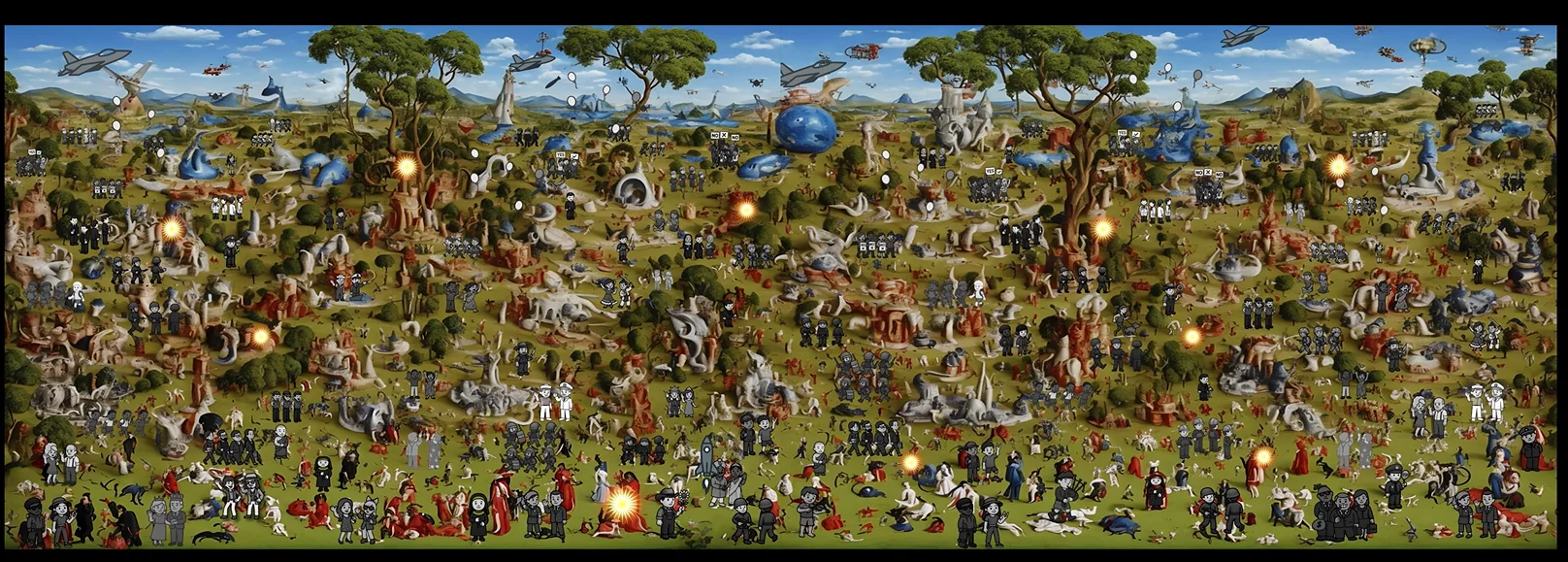
THE ARTWORK IS CURRENTLY EXHIBITED AT 10 INTERNATIONAL BEIJING BIENNALE 2025, BEIJING, CHINA
https://www.bjbiennale.com.cn/en/
https://www.bjbiennale.com.cn/en/
The Loop of Being is a large-scale animated projection, reimagining Bosch's Garden of Earthly Delights as a contemporary fresco of digital humanity. The full-color landscape is inhabited entirely by simplified, monochrome emoji-style characters. Each performs a single, looped action—walking, rocking, praying, shooting, working, consuming...—without interaction or progression.
The projection spans 10 meters by 3.5 meters and plays in a continuous loop. Characters from across social and economic backgrounds are placed side by side: judges, refugees, caretakers, prostitutes, shoppers, soldiers... Planes drop bombs in the background. Fireworks go off. Nothing resolves.
The installation does not follow a narrative or linear structure. Instead, it functions as a dense field of repeated gestures. Its focus is not on individual stories, but on simultaneous symbolic behaviors within a shared visual identity. It offers a literal depiction of coexistence as it often appears today: constant, fragmented, and uncoordinated - an image of the world not as a narrative, but as a system.
This is not merely a parody or pop-cultural update of Bosch's masterpiece, rather, it is a meditation on how symbols move and evolve. It's a landscape of algorithmic performance, where coexistence no longer means harmony, but simultaneity. Inspired by Bosch's spiritual allegory, The Loop of Being reflects a world where symbols loop, gestures flatten, and recognition becomes a political act.
A suggestion not of a narrative, but of the scale. This is not a story. This is a condition.
Inspired by Bosch's 15th-century masterpiece, this project draws on its original moral framework—not to replicate it, but to displace it. Bosch's triptych unfolded from Eden to Earth to Hell. Here, there is no progression—only simultaneity. No spiritual resolution, only continuous loops. This is not a vision of the afterlife but of right now.
The emoji-characters act as contemporary glyphs—flattened, repeated, and universally legible. They occupy every social position: the exploited and the entitled, the devout and the cynical, the powerless and the performative.
The Loop of Being exposes the contradiction at the core of the digital age: total visibility with no connection. Where Bosch imagined humanity caught between divine order and moral failure, The Loop of Being presents a world where symbolic gestures lack their outlined meaning—but still repeat. Each figure performs endlessly, not out of belief or purpose, but because the system runs on movement.
They become allegories of fission (conflict), growth (reproduction, labor), flow (movement, transaction), tempering (ritual, learning), and harmony (stillness, intimacy).
The emoji—commonly dismissed as trivial—here becomes a totem. Reduced from language to an icon, from body to sticker, the human becomes semiotic detritus, both everywhere and nowhere. The installation proposes a tension between the flattening of human complexity (emoji as shorthand for emotion and action) and the complexity of our ecological, social, and spiritual entanglements.
Set against the sound of the void, the characters' gestures become cosmic micro-loops: absurd & sacred & futile & eternal.
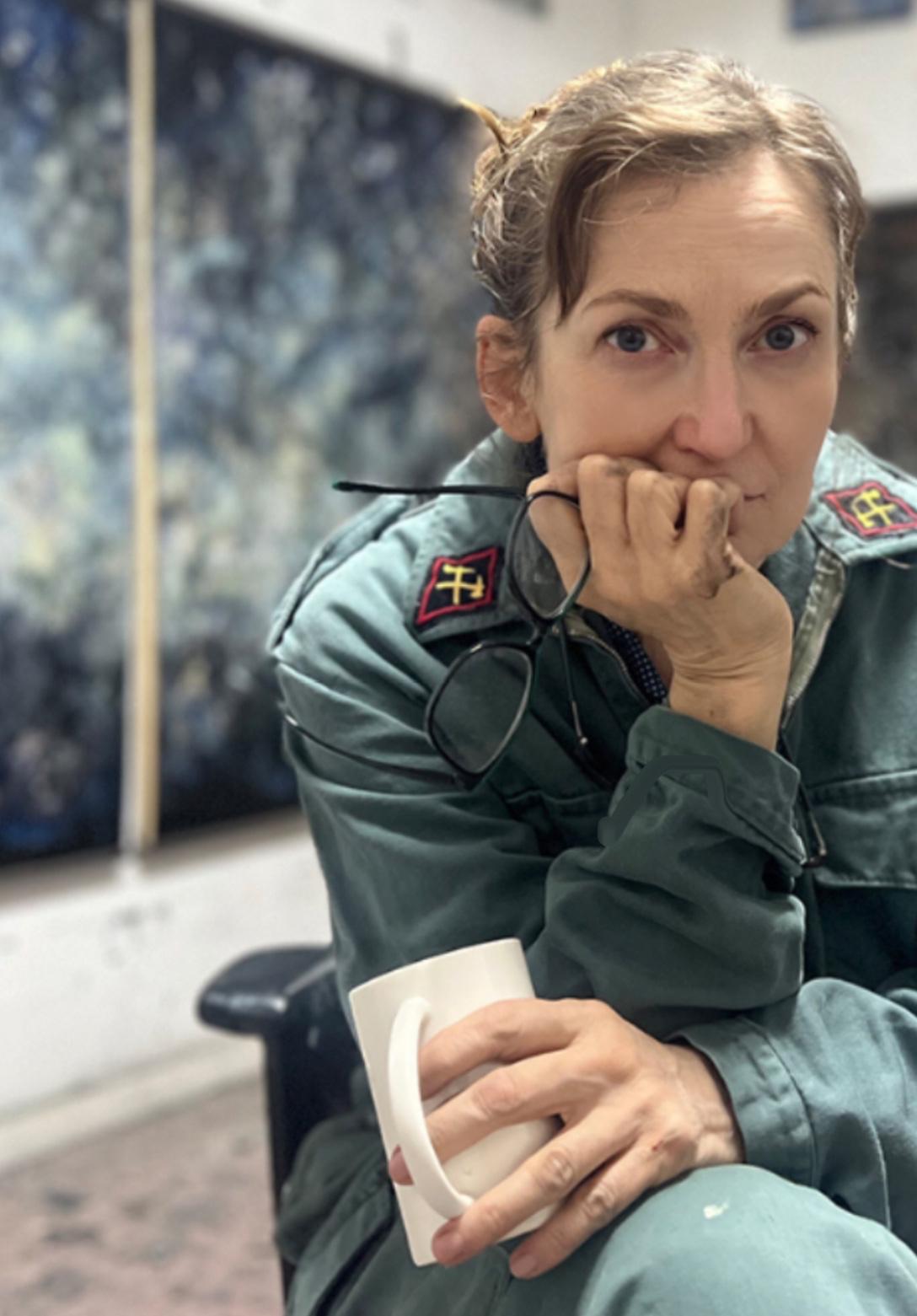
Visual Artist
The focus of my practice lies in examining the structures we live inside—social, symbolic, psychological—and the gestures we repeat within them. It is a multidisciplinary and concept-driven approach, shaped by the belief that form should follow thought. Drawing, installation, moving image, and performance are used as needed—each selected not for style, but for the clarity they can bring to a specific idea.
The Loop of Being arises from this ongoing inquiry. It began with a question: What does it mean to coexist when everything is visible but nothing connects? When gestures—of care, violence, consumption, denial—unfold simultaneously, everywhere, and endlessly?
By using the visual language of digital symbolism and animated repetition, the work attempts to simulate the density and dissonance of contemporary life. Yet it is not only a critique. It is also a space in which viewers may become momentarily disoriented—only to find themselves drawn toward the urge to interpret, to locate meaning, or to recognise the human fragments hidden within the noise.
This attention to systems, to patterns, and to the emotional residue they leave behind defines much of my practice. Not as a form of escape, and not to offer solutions—but to sharpen the way we see, and reconsider how we respond.
Tatjana Strugar is a multidisciplinary visual artist based between Belgrade and London. Trained in painting at the Academy of Fine Arts in Belgrade, her practice spans installation, video, drawing, and performance, with a focus on ritual, symbolic systems, and structures of visibility. Her concept-driven work resists stylistic uniformity, allowing each project to respond to its subject through the most fitting medium.
She has participated in numerous international and cross-disciplinary initiatives, including Imagine Art After (The Guardian, UK), Crisis (Goethe-Institut, Belgrade), and Communications (Kiosk NGO, South Serbia). Exhibitions of her work include presentations at the Freud Museum (London), the Triennale of Mixed Media (Belgrade), Sales Gallery (Belgrade), and Interior Design Gallery (Berlin).
Her early work included a notable act of institutional critique: installing the first ramp for mobility-impaired visitors at a Serbian gallery as part of her debut solo show. This gesture reflects her enduring interest in accessibility—not only physical, but conceptual—within the structures of art and society.

Multidisciplinary Artist & Innovator
My work delves into the fascinating space where virtual and physical realities merge, giving rise to hybrid "phygital" forms. Through the innovative use of IoT (Internet of Things) and simulation technologies, I create experiences designed to ignite a profound sense of presence, embodiment, and empathy.
I'm driven by a desire to reveal the underlying principles that shape our daily lives. By leveraging technology, my aim isn't to escape reality, but rather to deepen our human experience and understanding. My art invites viewers to not just observe, but to actively feel connected and present within these emergent, technologically-enhanced realities.
Natasha Bajc is a multidisciplinary artist and innovator, distinguished by her unique educational background encompassing a Master of Architecture from the Southern California Institute of Architecture (SCI-Arc) and a degree in Computer Science from the University of Southern California (USC).
Drawing on several decades of experience in commercial architecture practice, Natasha fluently bridges the gap between physical and digital spaces. Her extensive teaching career, spanning a decade, notably includes her role leading the Postgraduate 2 Advanced Program at UCLA's Graduate School of Architecture. For the past two decades, Natasha has been a pioneering presence in digital art, with her work featured at prominent venues such as the Skyline Digital Art Biennale in Los Angeles (2013, 2015) and the Architecture and Design Museum, Los Angeles (2014) as well as architecture biennale in Venice (2018).